How to Tell If Eggs Are Bad

Many people simply rely on the expiry dates printed on egg cartons when determining their freshness. They think that all eggs are fine to eat before the expiration date and completely inedible after the date. Such a rigid thinking discards the actual storage conditions and can often result in unnecessary throwing away of eggs or eating of bad eggs without realizing it.
Egg expiry dates are determined by assuming the eggs are kept in constant refrigeration. Eggs that are kept at room temperature will spoil three times faster than refrigerated ones even if they are still within the printed shelf life. The time factor alone doesn’t cause egg spoilage, it is actually due to bacterial invasion and the eggshell membrane breakdown that are the triggers for it.
This piece of writing lays out the main biological factor for egg spoilage, describes five subtle internal changes of deteriorated eggs, exposes three misleading egg freshness tests, and reveals several free household ways to tell bad eggs correctly.
The fundamental biologic principle of egg deterioration
While fresh whole eggs normally have two layers of innate natural protective barriers, the hard outer shell prevents external contamination by dust and microbes whereas the inner double-layered shell membrane blocks microbial invasion via the tiny shell pores.
As time passes or under the influence of high temperature, the shell membrane becomes decomposed and porous. Bacteria travelling through the air like Pseudomonas and Salmonella get through the shell pores into the egg white where they break protein molecules successively.
Bacterial metabolism results in the formation of hydrogen sulfide and ammonia within the egg. These gases build up and cause the internal air cell to expand, modify the egg’s density, and release unpleasant odors. Moreover, it leads to all the visible and tactile signs of spoiled eggs.
Five Subtle Signs of Spoiled Eggs
1. Floating in Room-Temperature Water
Fresh eggs have tiny air cells less than 4mm thick. Their overall density is higher than tap water, so they sink flat on the bottom of water containers.
Spoiled eggs have enlarged air cells over 10mm due to water evaporation and gas accumulation. Lower density makes them stand vertically or float completely on the water surface, marking irreversible internal deterioration.
2. Obvious Rattling Sound When Shaking
Fresh eggs have tight vitelline membranes fixing yolks in the center. Egg white viscosity is high with no free flowing space, so no sound appears during gentle shaking.
Degraded vitelline membranes let yolks drift freely. Thinned watery egg white flows randomly inside the shell. The collision between loose yolks and eggshells creates clear rattling noises.
3. Dull and Powdery Eggshell Surface
Newly laid fresh eggs have a smooth, waxy outer cuticle. This thin transparent film blocks shell pores and slows internal moisture loss.
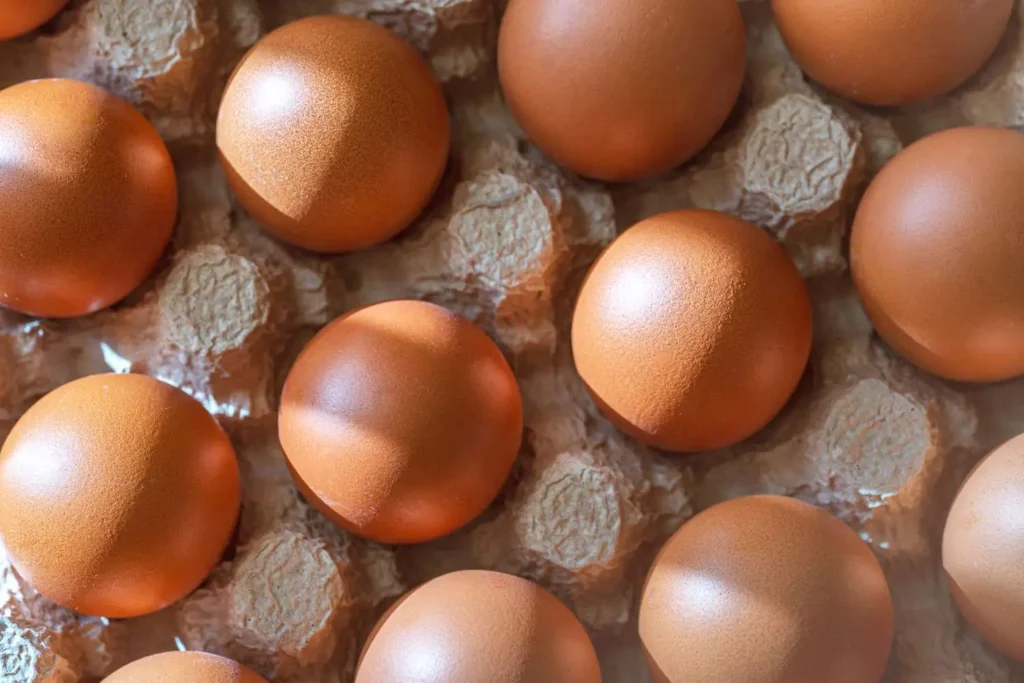
After two weeks of storage, the waxy cuticle wears off. The eggshell turns matte, rough and covered with fine powder. Worn cuticles cannot block bacteria, greatly raising spoilage risks.

4. Grey or Irregular Yolk Shape After Cracking
Usually, the yolk of fresh eggs is perfectly round, plump and has a nice elasticity. It is also encircled by a thick and cloudy egg white. When the yolk is pressed gently, for instance, with chopsticks, it will respond by slightly bouncing back.
On the contrary, spoiled yolks lose their shape and easily flatten and spread. It is a result of intense bacterial contamination that the yolks even turn pale grey. At the extreme level, the yolks may get completely mixed with the egg white, and there will be no difference by the naked eye.
5. Sulfuric or Sour Internal Odor
When fresh, eggs only have a very light neutral earthy smell and definitely no unpleasant or off-putting scent. Also, the smell is closely guarded by the unbroken membranes and can’t get out of the shell.
Hydrogen sulfide that is metabolized is responsible for the rotten sulfur smell, whereas bacteria that cause spoilage give off an ammonia-like sour smell. As soon as the shell is broken, the smell is clearly noticeable and is a sign of an unsafe level of bacteria.
Egg Freshness Misconceptions to Ignore
Considering freshness just by eggshell color. The color of an eggshell, whether brown or white, is determined by the breed of the hen and has nothing to do with how fresh the egg is. The darkening of the shell due to oxidation is unrelated to the level of bacteria inside.
Doing the light test with the naked eye. Any dirt or stains that cover the shell will prevent light from passing through, thereby making even fresh eggs appear dark. Use of this method in everyday is responsible for almost 20% of the wrong decisions.
Thinking that the eggs are safe just because they have been in the fridge for some time. Refrigeration merely overcomes membrane weakening and degradation. Eggs bought infected will spoil rapidly even if kept at a constant cool temperature.
Egg Testing Techniques That Are Supported by Science
Basically, the very first step is to administer the cold water floating test. In fact, you should take 20℃ tap water to determine the density accurately and avoid that the temperature affects the test result in any way.Secondly, do the slight ear shaking. Before cracking the eggs, you can find out if the internal parts are loose by detecting the rattling sound so that you don’t cross-contaminate fresh eggs.T hen, the egg white stratification at the egg cracking should be checked. Fresh eggs have separate layers of thick and thin whites, whereas spoiled eggs have uniform watery whites.
Last but not least, do a sniff test right after cracking. If the smell is of ammonia or sulfur, don’t use the egg – throw it away immediately without having a second use.
Conclusion
Egg spoilage originates from worn shell cuticles and internal bacterial reproduction. Floating posture, shaking sound, shell texture, yolk shape and peculiar odor are five reliable identification indicators.
Shell color judgment, light penetration and time-only judgment are inaccurate misleading methods. Water testing and odor checking are stable low-cost identification skills.
Combining two or more detection methods can accurately distinguish spoiled eggs, preventing salmonella food poisoning in daily cooking.